Area
88, 752 sq km

Industrial investment and policy for Viksit Bharat 2047. Evidence reviewed as of 1 November 2026; document dates and unresolved gaps remain explicit.
Read or download investor brochure
88, 752 sq km
Kolkata
Bihar, Jharkhand, Odisha, Sikkim, Assam
Bangladesh, Nepal and Bhutan borders; Bay of Bengal coast
Tea, petrochemicals, leather, iron/steel, IT, fisheries, jute and textiles
Kolkata/Haldia port system; proposed new ports not assumed operational
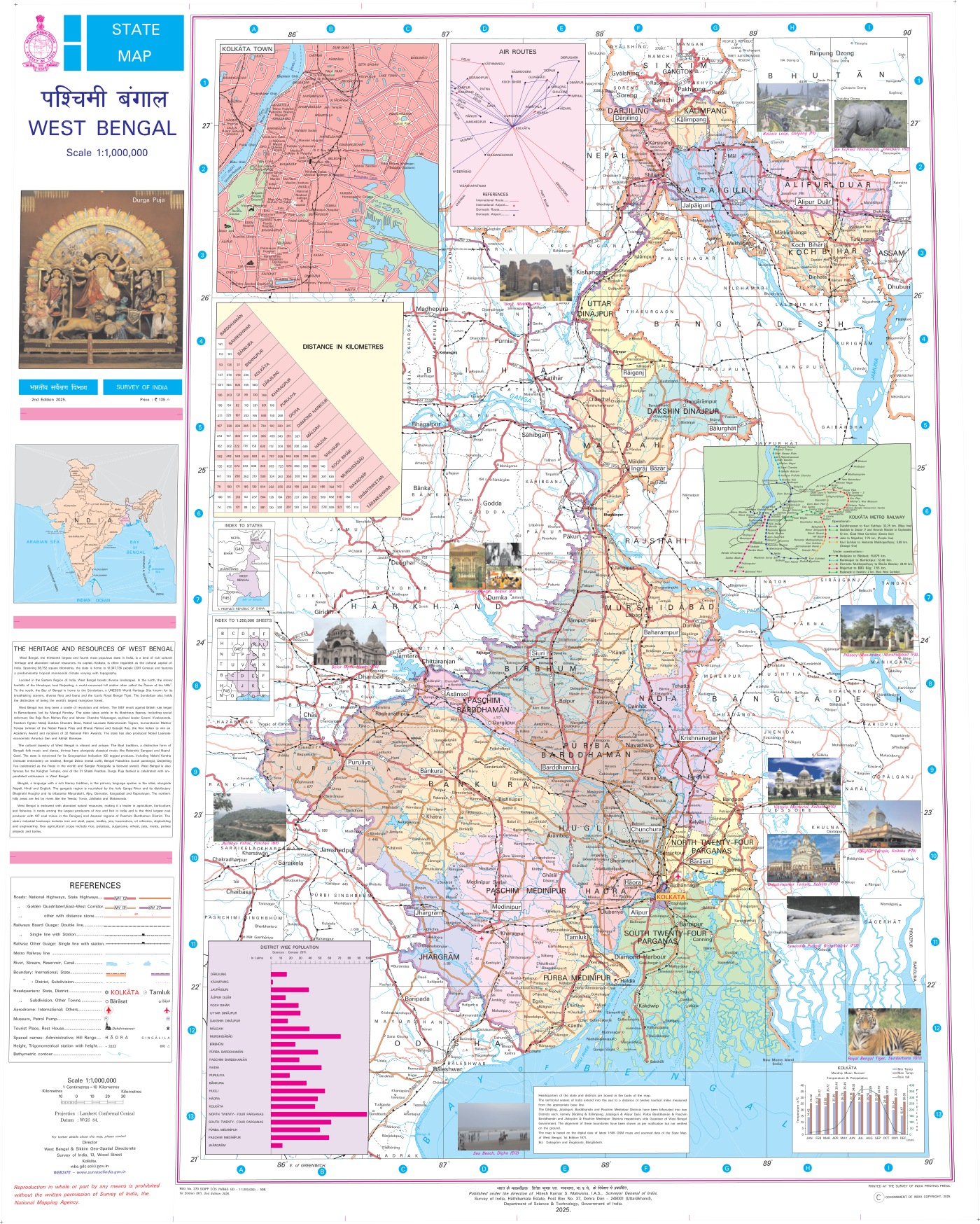
Survey of India, Government of India
Evidence. Official profile identifies tea, fisheries and agricultural resources.
Commercial case. Grading, traceability, processing and packaging serve existing production and demand.
Exposure. Food safety, seasonality, cold-chain uptime and buyer standards.
Investment gate. Compare origin processing in North Bengal with Kolkata-region distribution using product-specific catchments.
Evidence. International borders, existing ports and official logistics framework support a market-access thesis.
Commercial case. Multiple cargo owners can diversify demand.
Exposure. Border procedures, backhaul balance, port draft compatibility and flood exposure.
Investment gate. Obtain current route quotations, cargo commitments and parcel flood/drainage assessment.
Evidence. Iron/steel, automotive components, petrochemicals and IT appear in the official profile.
Commercial case. Repair, fabrication and digitisation can serve a varied industrial base.
Exposure. Qualification, competition, power quality and old-estate servicing.
Investment gate. Compare locations on customer response time and actual utilities, not advertised subsidy.
Status. Existing urban/port-industrial geography; site servicing unverified
Fit. Distribution, processing, industrial services
Status. Existing geography; proposed corridors not counted ready
Fit. Tea value addition and regional distribution
Route. NH-19 and NH-16 form identified trunk links; test Howrah-Kolkata and Haldia approaches separately.
Status. Existing corridors; WBIDC describes Kolkata-Varanasi, Raxaul-Haldia, Kharagpur-Moregram and Siliguri-Gorakhpur greenfield expressways as under development.
Industrial relevance. Regional engineering distribution and food movement need a route from the production catchment to the actual customer/port gate.
Investor test. Use a gate-specific truck survey including entry restrictions, staging, drainage and alternate access; do not book savings from proposed expressways.
Route. Howrah-Haldia electrified rail alignment; port-adjacent Haldia industrial geography.
Status. Existing railway/port context; a plot siding and dedicated cargo path are separate approvals.
Industrial relevance. Assess petrochemical/engineering inputs and outward products by cargo class and berth/handling compatibility.
Investor test. Obtain terminal access, unloading arrangements, freight quote and wagon/rail service commitment.
Route. Kolkata Dock System and Haldia port system.
Status. SMP recorded an actual midstream container operation in April 2026; this is a demonstrated operation, not a promised regular service.
Industrial relevance. Compare conventional berth and eligible barge/ship interfaces for the project’s container, bulk or project cargo.
Investor test. Check vessel and parcel compatibility, published sailing, tidal/draft window, handling charges and demurrage allocation.
Route. Haldia MMT / NW-1 and India-Bangladesh Protocol route context.
Status. Haldia terminal developed; IWAI identifies ongoing MMT rail connectivity. International routing remains subject to current protocol/customs permissions.
Industrial relevance. Candidate for suitable northern-hinterland cargo aggregation; do not assume container liner frequency from geography.
Investor test. Obtain route permission, actual operator timetable, draft and first/last-mile quote; test a road/rail fallback.
Route. Kolkata and Bagdogra cargo infrastructure; split southern industrial and northern agricultural catchments.
Status. AAI lists cargo handling; current accepted commodities and direct services not verified.
Industrial relevance. Investigate Kolkata for time-critical industrial freight and Bagdogra for suitable northern produce after airline confirmation.
Investor test. Validate terminal customs/cold-chain scope, destination transfer and shipment economics; passenger flight connectivity alone is insufficient.
Status. Historical; not open new 2026 production
Benefits. Historical micro Zone C/D/E capital 25/40/60%; small 15/30/40%. Do not market these as current offer.
Eligibility. Commercial production 1 Apr 2019-31 Mar 2025; first application within 12 months subject scheme rules.
Window. Scheme 1 Apr 2020-31 Mar 2025; last example first claim 30 Mar 2026. No extension verified.
Status. Official originals located; fiscal clauses not fully reviewed
Benefits. Facilitation framework; no blanket cash rate asserted.
Eligibility. Project type, permitted use, applicable status and approval route require verification.
Window. Current general 2026 industrial successor not established; Cabinet-stage material excluded.
Diversified industrial/agricultural economy plus a metropolitan and port gateway.
Long north-south geography complicates a single-site catchment strategy.
Banglashree new-production window is closed.
Food traceability, cold logistics and industrial services fit existing activity.
Border-route disruption and coastal/river site exposure need explicit sensitivity testing.
Old scheme listings may overstate available fiscal support.
Constraint. The long north-south catchment makes a single processing/warehouse location a weak default.
Intervention. Place primary aggregation near origin and consolidation near the chosen market/gateway; contract the inter-node cold chain.
Action owner. Processor and specialist 3 PL
Opportunity. Traceable tea/food value addition and multi-customer temperature-controlled distribution.
Commercial gate. Origin volumes, temperature logs, dwell limits and buyer acceptance must support both nodes.
Residual risk. Two nodes add fixed cost and handling; the design can be uneconomic at low volume.
Constraint. LEADS contains stakeholder-reported port approach congestion, waterlogging and service variability, not an engineering audit.
Intervention. Validate the bottleneck locally; establish off-port staging, appointment dispatch and resilient drainage where permitted.
Action owner. Port/estate authority plus private terminal or warehouse operator
Opportunity. Truck holding, cross-dock and cargo-visibility services tied to committed throughput.
Commercial gate. Access permission, recurring customers and measured turnaround improvement.
Residual risk. Public-road and port operating changes can affect the business; no guaranteed saving asserted.
Constraint. Waterway and river-port access require vessel, handling and schedule compatibility.
Intervention. Bundle cargo into a pilot service and compare inventory-adjusted cost with road/rail; retain a backup gateway.
Action owner. Shipper, barge operator, terminal and shipping line
Opportunity. Contracted hinterland aggregation and barge-to-port handling for qualified cargo.
Commercial gate. Executed trial, lawful route, shipment insurance and confirmed sailing connection.
Residual risk. Draft/seasonal or shipping-line changes can remove the advantage.
No selected-site flood/drainage survey, port berth/cargo booking, sailing schedule or current cross-border restriction assessment.
New expressway route completion and proposed ports not independently commissioned here.
Central policy, FDI, tax, customs, environment, workforce and remittance guide · Single canonical evidence repository
STARTUP POLICY · CHECKED 4 NOVEMBER 2026
State Industries and Startup India still list 2016–2021 policy. Replacement/extension original not verified; original PDF retrieval remains incomplete.