Capital / administrative centre
Chandigarh (shared capital; separate UT)

Industrial investment and policy for Viksit Bharat 2047. Evidence reviewed as of 1 November 2026; document dates and unresolved gaps remain explicit.
Read or download investor brochure
Chandigarh (shared capital; separate UT)
50, 362 km² (2026 industrial-policy state profile)
Agricultural plains with established engineering, textile and sports-goods clusters. Ocean exports require inland transport; border proximity is not proof of usable international trade.
Jammu & Kashmir UT, Himachal Pradesh, Haryana, Rajasthan and Chandigarh UT; Pakistan international border.
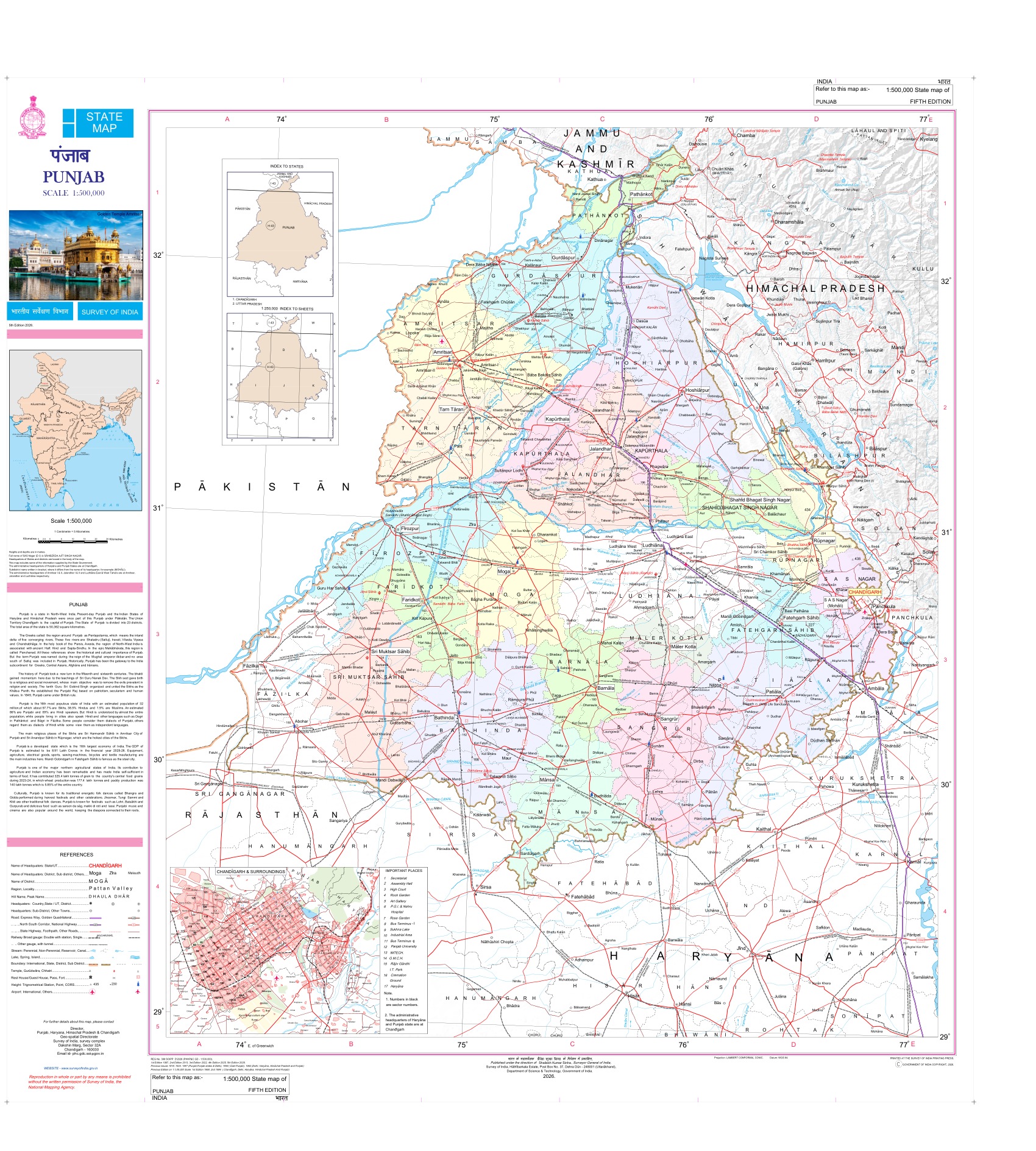
Official geographic context, resized; original source retained. PBMAPV
Evidence. The 2026 policy identifies cluster committees for bicycles, automotive/forgings and textiles.
Commercial case. Improve precision, traceability and product qualification around existing industrial suppliers.
Exposure. Legacy process quality, energy cost and OEM transition.
Investment gate. Obtain buyer-approved process specifications and a realistic modernisation plan.
Evidence. Sports goods are a priority sector in clause 4.4; cluster representation is documented.
Commercial case. Build compliant export products, materials testing and branded contract manufacturing.
Exposure. International standards, seasonal orders and product-liability exposure.
Investment gate. Secure buyer sampling acceptance, test certificates and worker-compliance audits.
Evidence. Agri-food processing is a priority sector; policy also identifies agro-waste conversion.
Commercial case. Contract residue-safe food inputs and useful by-products rather than assume all farm output is available cheaply.
Exposure. Water pressure, crop price volatility and export-policy changes.
Investment gate. Verify feedstock, water balance, buyer contracts and food/product approvals.
Rationale. Improve precision, traceability and product qualification around existing industrial suppliers.
Rationale. Build compliant export products, materials testing and branded contract manufacturing.
Rationale. Contract residue-safe food inputs and useful by-products rather than assume all farm output is available cheaply.
Assessment. NH 44 and links from Ludhiana/Jalandhar/Amritsar to NCR and western routes underpin industrial distribution.
Status. Official map context; commercial transit audit pending
Assessment. CONCOR lists Dhandari Kalan, Ahmedgarh, Phillaur, Suranussi and Dhappar cluster facilities. Use rail/road quotes to western ports; a border crossing is not a reliable base-case export assumption.
Status. Terminals listed; train and vessel acceptance unverified
Assessment. Amritsar and Mohali provide gateway options; 2026 policy records air-cargo facilities, but cold-chain/customs product acceptance must be checked.
Status. Dated policy facility reference, no scheduled service promise
Assessment. No verified inland-water freight base case. Agricultural/industrial water competition requires a documented source and recycling plan.
Status. Site water authorisation pending
Benefits. Eligible capital subsidy up to 20% of eligible FCI capped at ₹ 10 crore; net SGST reimbursement 75%, each subject to annual and overall ceilings and eligibility-period rules.
Conditions. Capital subsidy is residual after other admissible annual incentives. MSMEs require ZED Bronze at ICAF approval for post-production incentives. Overall ceiling and sector/location classification apply.
Status. Gazette 8 March 2026; current original supersedes reliance on 2022 summaries. Implementing notifications/portal acceptance still need project confirmation.
Checked pages. PDF pp 14-21; clauses 4.2-4.4, 5.1-5.2.4
Benefits. Priority sectors receive distinct overall-ceiling treatment within the same framework, not an independent additive grant.
Conditions. Textile dyeing/finishing counts as priority only with ZLD. Priority/Border/Kandi ceiling must be applied with annual caps.
Status. Original sector list verified; separate sector guideline should be added where it changes entitlement.
Checked pages. PDF pp 15-16; clauses 4.4, 5.1.1
Benefits. Eligible existing manufacturing modernisation can receive 20% of eligible P&M, capped₹ 10 crore, in 10 annual instalments.
Conditions. Modernisation definitions in DSOG 2026 apply; once in five years; expansion-with-modernisation follows the expansion route instead.
Status. Original benefit verified; DSOG details and application acceptance remain to be checked.
Checked pages. PDF p 20; clause 5.2.2(B)
Specialised supplier clusters already exist.
Several rail/container and air gateway options are documented.
Ocean shipments carry an inland transport leg.
Water and resource-intensive processes require careful siting.
Modernisation can improve export qualification and resource efficiency.
Agro-waste utilisation can build contracted input businesses.
Border trade access and international demand can change.
Annual incentive ceilings can make realised cash support lower than headline rates.
Constraint. Legacy SME production methods
Intervention. Invest in metrology, traceability and audited modernisation
Owner. Manufacturer and anchor buyer
Opportunity. Higher-specification export components
Prerequisite. Buyer qualification and DSOG eligibility
Residual risk. Technology and demand change remain
Constraint. Water-intensive textile processing
Intervention. Adopt compliant recycling/ZLD and shared testing
Owner. Cluster association and processor
Opportunity. Approved technical textiles and environmental services
Prerequisite. Water source, disposal permissions and viable treatment charges
Residual risk. Concentrate disposal and energy cost remain
Constraint. Agricultural residue disposal challenge
Intervention. Contract clean segregated biomass and stable offtake
Owner. Processor, farmers and energy/material buyers
Opportunity. Agro-waste value addition
Prerequisite. Feedstock logistics, emissions approval and purchase agreement
Residual risk. Seasonal supply and competing uses remain
Verify DSOG 2026, relevant implementing notifications and incentive portal workflow before producing a quantified project cash-flow model.
No guaranteed subsidy cash flow: validate eligibility, budget, application acceptance and stacking for the particular legal entity before financial close.
Cargo, port, railway service frequency, terminal capacity, routes, freight quotes, water allocation and plot availability require project-specific current evidence. No passenger flight is represented as a scheduled freighter.
Central FDI/FEMA, customs, tax, sector licensing and scheme windows are to be read with the common national legal guide; state incentives do not override them.
Central policy, FDI, tax, customs, environment, workforce and remittance guide · Single canonical evidence repository
STARTUP POLICY · CHECKED 4 NOVEMBER 2026
Official 2026 policy published on Invest Punjab; several fiscal procedures expressly require separate DSOG/notifications.