Capital / administrative centre
Leh and Kargil administrative centres; seven districts following notification of Nubra, Sham, Changthang, Zanskar and Drass on 27 April 2026.

Industrial investment and policy for Viksit Bharat 2047. Evidence reviewed as of 1 November 2026; document dates and unresolved gaps remain explicit.
Read or download investor brochure
Leh and Kargil administrative centres; seven districts following notification of Nubra, Sham, Changthang, Zanskar and Drass on 27 April 2026.
59, 146 km² (Mo EF profile citing 2025 PWD basis; not a territorial-claim adjudication)
High-altitude cold desert with fragile ecology, dispersed settlements and seasonal road dependence. Prefer high-value low-volume and resource-efficient projects; large-water or bulk-logistics assumptions require exceptional evidence.
Jammu & Kashmir UT and Himachal Pradesh; international and disputed-boundary annotations only as on the official SOI map.
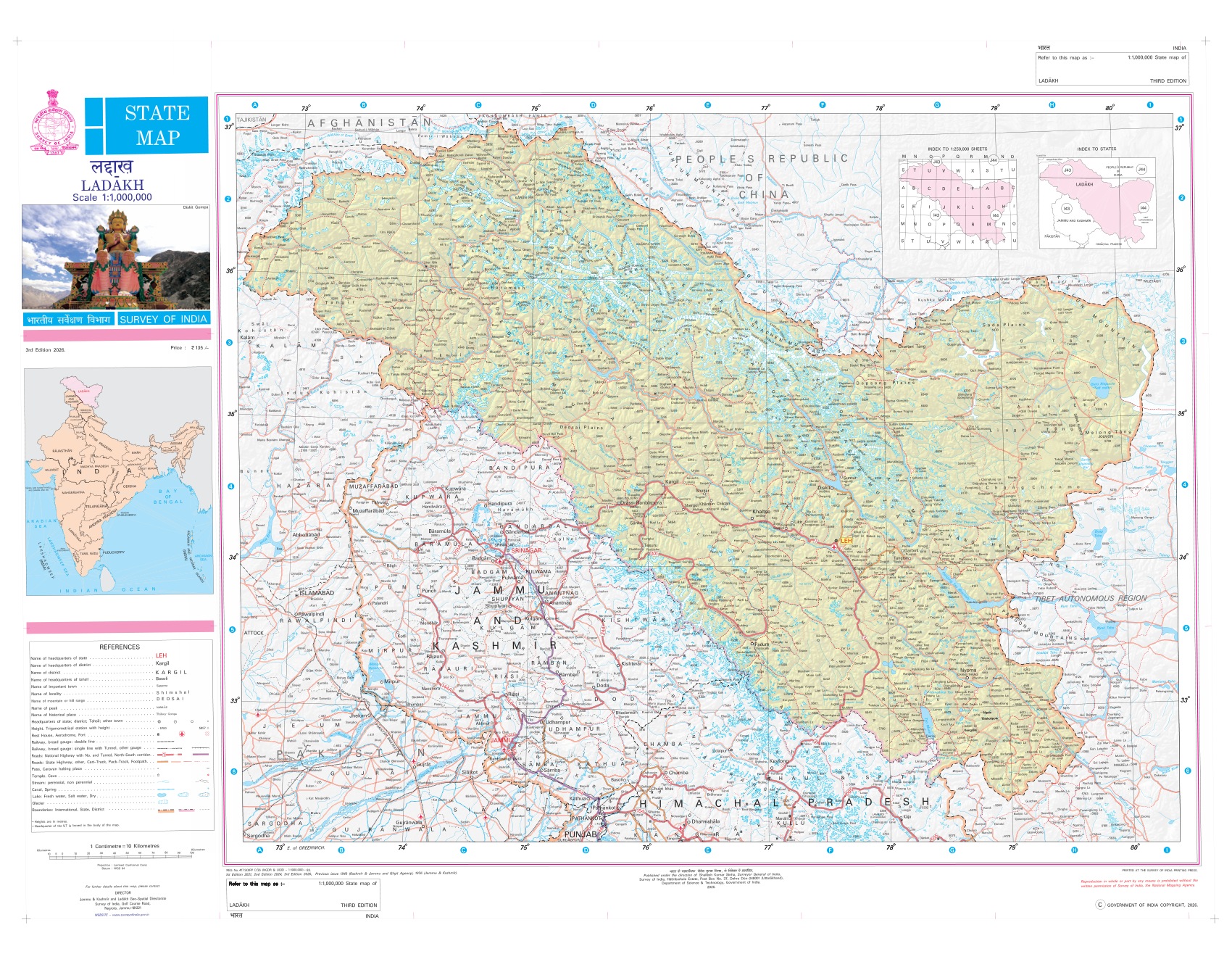
Official geographic context, resized; original source retained. LDMAPV
Evidence. Sustainable Industrial Policy 2022-27 identifies local resources and value-addition priorities.
Commercial case. Use traceable aggregation, drying/extraction and quality control to improve value per kilogram moved.
Exposure. Limited raw material, seasonality, yield uncertainty and ecological limits.
Investment gate. Verify sustainable procurement rights, processing yield, food/product approvals and contracted demand.
Evidence. Policy recognises traditional resources and skills and support for quality/marketing.
Commercial case. Improve traceability, finishing and buyer assurance rather than compete on bulk factory scale.
Exposure. Provenance, small volumes and specialist skill retention.
Investment gate. Establish genuine fibre sourcing, product standards and confirmed orders.
Evidence. Policy expressly incentivises green-energy installations, wastewater recycling and quality equipment within conditions.
Commercial case. Provide maintainable systems adapted to altitude/cold and actual local loads.
Exposure. Winter performance, imported spares and low customer density.
Investment gate. Pilot performance, maintenance logistics and customer payment model before rollout.
Rationale. Use traceable aggregation, drying/extraction and quality control to improve value per kilogram moved.
Rationale. Improve traceability, finishing and buyer assurance rather than compete on bulk factory scale.
Rationale. Provide maintainable systems adapted to altitude/cold and actual local loads.
Assessment. Srinagar-Kargil-Leh and Manali-Leh routes underpin supplies, with high-altitude/seasonal exposure. Existing road presence is not proof of uninterrupted winter availability.
Status. Policy/map geography; route-opening and heavy-load checks needed
Assessment. No operating railway within Ladakh is established in the reviewed evidence. Base case transfers by road/air to external rail/port gateways; proposed lines are not operating assets.
Status. No local operating rail service verified
Assessment. Leh is a relevant airport gateway. Policy subsidises eligible outward domestic air freight, which does not establish current carrier capacity, cargo acceptance or international service.
Status. Actual freight uplift and cold-chain acceptance require quotation
Assessment. No inland-water cargo base case. Water scarcity, waste disposal and fragile high-altitude ecology must be treated as design limits.
Status. Physical and permitting gate
Benefits. Eligible domestic outward finished-goods air freight: 50%, up to₹ 5 lakh/year for five years; green-energy assistance 50% up to₹ 25 lakh for specified systems and eligible units.
Conditions. Transport subsidy OR export subsidy, not both. Green-energy equipment 10-2000 k W and minimum₹ 25 lakh project; existing units have DG-replacement condition. Payment follows operational verification.
Status. Five years from notification; confirm exact effective date and current amendments before entitlement.
Checked pages. LD 01 PDF pp 19-22; clauses 6.3-6.4, 7.2
Benefits. Testing/certification assistance 35% up to₹ 5 lakh; wastewater equipment 50% up to₹ 2 lakh, excluding civil works.
Conditions. Testing equipment cannot be ordinary production machinery; recognised quality certification and eligibility required. These are parts of the same policy, not additive independent schemes.
Status. Original clauses verified; claim procedure and budget require confirmation.
Checked pages. PDF p 20; clauses 6.4-6.5
Benefits. SIDCO administers industrial-land development and allotment under the March 2026 amendment. The October amendment requires a transparent competitive mechanism among eligible applicants.
Conditions. The 3 August 2026 amendment remains missing. Do not treat the 2025 policy plus March/October orders as a fully consolidated eligibility, lease or payment opinion. Earlier allotments remain governed by applicable terms unless lawfully modified.
Status. March and October 2026 clauses checked; August amendment and SIDCO SOP remain unresolved.
Checked pages. March order: PDF pp.2-4 and 7; October order: PDF pp.2-3
Distinctive local products can support value-dense differentiated output.
Original policy addresses transport and resource-efficiency constraints.
Altitude, seasonal transport and sparse suppliers raise operating cost.
Water, waste capacity and ecological constraints limit scale.
Quality/traceability can improve realised value of existing local resources.
Maintainable clean-energy and cold-chain systems can serve existing units.
Winter isolation, weather and equipment failure can interrupt production.
Scaling beyond sustainable feedstock and water limits can destroy viability.
Constraint. High outbound freight per unit
Intervention. Increase value density through grading, drying and authenticated packaging
Owner. Processor, producer groups and buyers
Opportunity. Premium local products
Prerequisite. Yield testing, sustainable sourcing and confirmed market
Residual risk. Air capacity and price remain volatile
Constraint. Seasonal energy/cold-chain weakness
Intervention. Pilot insulated storage and suitable renewable/hybrid systems with spares
Owner. Operator, energy supplier and technical institution
Opportunity. Maintenance-backed energy services
Prerequisite. Altitude/cold performance test and financeable customer demand
Residual risk. Winter intermittency and spare-parts delay remain
Constraint. Scarce water and waste capacity
Intervention. Install measurable reuse and low-water processing
Owner. Investor and UT pollution/utility authorities
Opportunity. Resource-efficiency services
Prerequisite. Legal abstraction/discharge, validated treatment and safe residues
Residual risk. Ecological carrying capacity still caps growth
Critical: reconcile March and October 2026 land amendments before advising foreign/local investor eligibility or lease terms.
Confirm policy notification start date, current district reorganisation, seasonal route opening and actual air-cargo acceptance.
No guaranteed subsidy cash flow: validate eligibility, budget, application acceptance and stacking for the particular legal entity before financial close.
Cargo, port, railway service frequency, terminal capacity, routes, freight quotes, water allocation and plot availability require project-specific current evidence. No passenger flight is represented as a scheduled freighter.
Central FDI/FEMA, customs, tax, sector licensing and scheme windows are to be read with the common national legal guide; state incentives do not override them.
Central policy, FDI, tax, customs, environment, workforce and remittance guide · Single canonical evidence repository
STARTUP POLICY · CHECKED 4 NOVEMBER 2026
DPIIT’s July 2026 directory says policy being conceptualised; an official 19 August 2026 release discusses amendments/revised support, but no consolidated operative instrument was located.