Capital / administrative centre
Jammu and Srinagar administrative centres; verify seasonal departmental location

Industrial investment and policy for Viksit Bharat 2047. Evidence reviewed as of 1 November 2026; document dates and unresolved gaps remain explicit.
Read or download investor brochure
Jammu and Srinagar administrative centres; verify seasonal departmental location
42, 241 km² (Mo EF statistical-profile basis; official map territorial annotations remain controlling for the map).
Himalayan UT with Jammu plains/foothills and Kashmir valley. Treat districts separately for transport, climate, land and operating conditions; use official post-reorganisation boundaries.
Punjab, Himachal Pradesh and Ladakh UT; international/Line-of-Control annotations must be reproduced exactly from SOI, not redrawn from a foreign map.
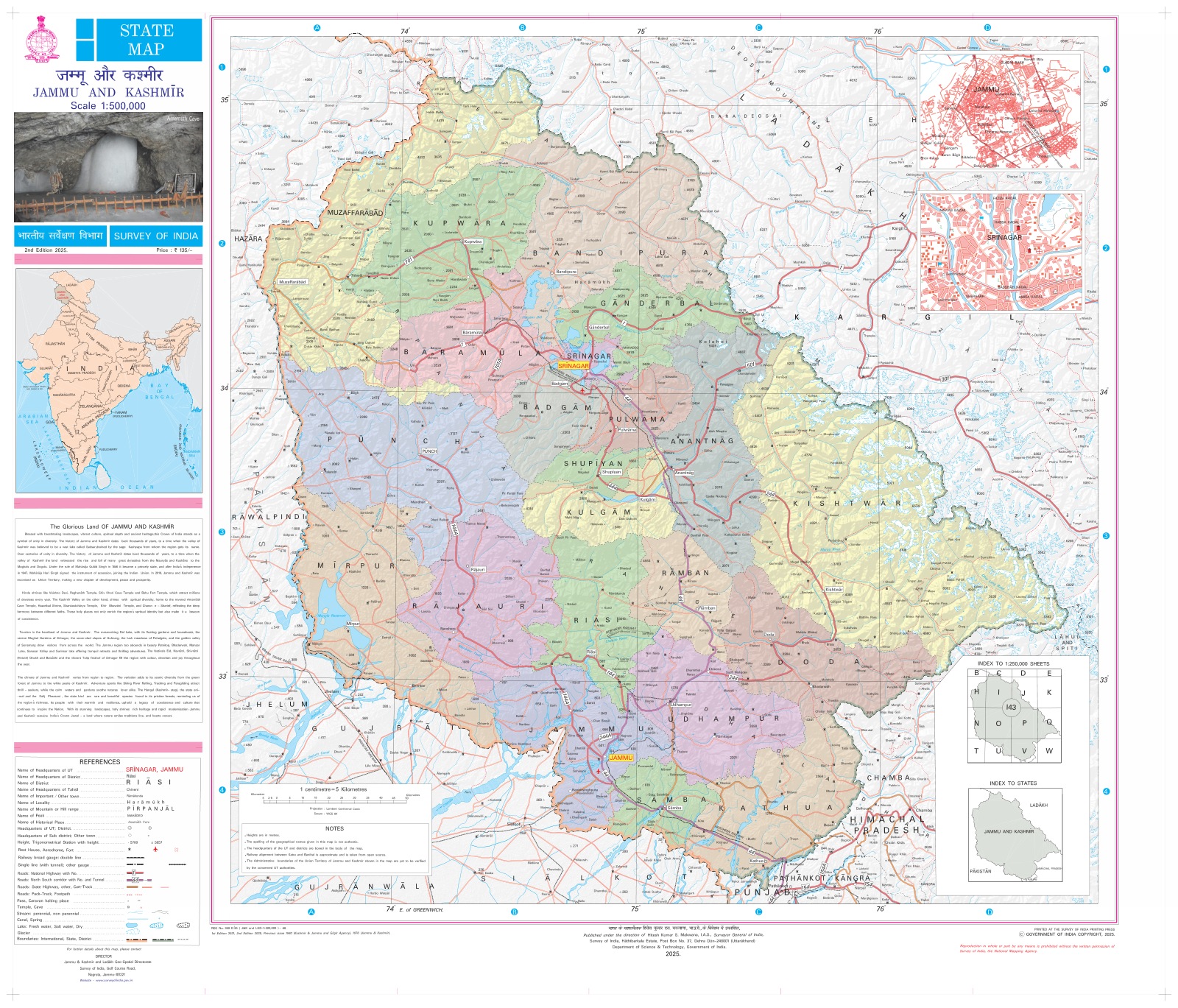
Official geographic context, resized; original source retained. JKMAP
Evidence. Industrial Policy 2021-30 defines manufacturing eligibility and UT incentives.
Commercial case. Evaluate mainland-facing supplier production with land/utility access rather than treating all UT sites alike.
Exposure. Approved land availability, supply contracts and incentive-window uncertainty.
Investment gate. Obtain allotment/title, CTE, utility commitments and market cost model without assuming new NCSS registration.
Evidence. Railways documents first Kashmir freight in August 2025 and foodgrain movement to Anantnag later 2025.
Commercial case. Test consolidation, controlled storage and processing against actual crop volumes; new freight access expands options but does not prove reefer service.
Exposure. Seasonality, grade losses and unverified rail cold-chain capability.
Investment gate. Contract producers/buyers and obtain terminal, wagon/container and temperature-control quotations.
Evidence. Industrial framework covers eligible manufacturing and specified services.
Commercial case. Build authenticated quality, finishing and export services where value density can absorb long-distance logistics.
Exposure. Counterfeit provenance, inconsistent quality and volatile demand.
Investment gate. Verify artisan sourcing, GI/IP use, product testing and international buyer requirements.
Rationale. Evaluate mainland-facing supplier production with land/utility access rather than treating all UT sites alike.
Rationale. Test consolidation, controlled storage and processing against actual crop volumes; new freight access expands options but does not prove reefer service.
Rationale. Build authenticated quality, finishing and export services where value density can absorb long-distance logistics.
Assessment. Jammu-Srinagar NH 44 and district access remain crucial; interruptions, winter requirements and inventory buffers must be modelled.
Status. Mapped corridor; no uninterrupted all-weather transit promise
Assessment. First freight reached Kashmir in August 2025; 2025 official review records foodgrain movement to Anantnag. Do not describe Kashmir as lacking rail freight, or infer high-frequency refrigerated service from inaugural traffic.
Status. Freight operation documented in 2025; 2026 capacity/service quote pending
Assessment. Jammu and Srinagar are management and potential high-value cargo gateways; current commodity/cold-chain acceptance must be verified.
Status. Airport geography, not current service guarantee
Assessment. Lakes/rivers are not an evidenced industrial export waterway. Use rail/road/air alternatives and separate industrial water permissions.
Status. No verified commercial bulk-water route
Benefits. Original includes stamp-duty exemption on government-industrial-estate land transactions, quality-certification and automation support.
Conditions. Manufacturing negative list and service positive list apply; production certification by GM DIC precedes disbursement. Each incentive has distinct beneficiary and cap rules.
Status. Original order 117 and procedure 118 retrieved; latest amendments still need reconciliation.
Checked pages. JK 01 PDF pp 17-22; clauses 4.1-4.5
Benefits. Provides central industrial-development incentives for eligible registered units; it must be treated separately from UT policy.
Conditions. Original registration window ended 30 September 2024; official 30 July 2024 notice closed portal pending DPIIT clarification. Existing approved beneficiaries and new applicants are different cases.
Status. NO verified current new-registration window. Do not advertise as open to a new 2026 investor.
Checked pages. Original registration clause and full one-page closure notice
Benefits. Official 2022 foreign-investment link retrieved but returned a 373-page composite; instrument identity and operative pages need extraction.
Conditions. Foreign equity does not dispense with FEMA, sector rules, land eligibility or environment approvals.
Status. Composite preserved; no quantitative benefit or open route claimed.
Checked pages. Document identity unresolved within composite
Jammu and Kashmir offer distinct production and resource profiles.
Documented rail freight to Kashmir expands logistics alternatives.
Seasonal/weather exposure and terminal capability require detailed route design.
New central-scheme registration is not established as open.
Contracted horticultural logistics may improve saleable quality.
Mainland-facing supplier services can be evaluated in Jammu belt.
Operational interruptions and market access can affect inventory economics.
Unreconciled amendments or closed registration can invalidate subsidy assumptions.
Constraint. Perishable losses and seasonal dispatch
Intervention. Develop contract-backed grading/storage and test rail versus road routes
Owner. Processor, grower groups and logistics provider
Opportunity. Higher saleable yield and quality services
Prerequisite. Terminal acceptance, temperature validation and buyers
Residual risk. Weather and demand risks remain
Constraint. Supply-chain interruption exposure
Intervention. Create measured buffer inventories and dual transport options
Owner. Investor and freight operator
Opportunity. Reliable regional supply services
Prerequisite. Route contingency, insurance and working capital
Residual risk. Severe disruption remains possible
Constraint. Uncertain incentive access
Intervention. Underwrite unsubsidised base case and verify existing approvals separately
Owner. Investor, legal adviser and scheme authority
Opportunity. Projects selected for genuine market viability
Prerequisite. Written eligibility/registration evidence before recognising support
Residual risk. Disbursement and policy changes remain
Critical: current NCSS registration status cannot be inferred from scheme duration 2037; original registration window and portal closure require current original clarification.
Extract the actual 2022 foreign-investment order from the 373-page composite before citing clauses.
Official current area/statistical profile and latest UT-policy amendments need verification.
No guaranteed subsidy cash flow: validate eligibility, budget, application acceptance and stacking for the particular legal entity before financial close.
Cargo, port, railway service frequency, terminal capacity, routes, freight quotes, water allocation and plot availability require project-specific current evidence. No passenger flight is represented as a scheduled freighter.
Central FDI/FEMA, customs, tax, sector licensing and scheme windows are to be read with the common national legal guide; state incentives do not override them.
Central policy, FDI, tax, customs, environment, workforce and remittance guide · Single canonical evidence repository
STARTUP POLICY · CHECKED 4 NOVEMBER 2026
2024–27 policy operation corroborated by official JKEDI 2026 funding notice; full official policy/guideline copy not recovered in this check.