Capital / administrative centre
Shimla; Dharamshala is winter capital

Industrial investment and policy for Viksit Bharat 2047. Evidence reviewed as of 1 November 2026; document dates and unresolved gaps remain explicit.
Read or download investor brochure
Shimla; Dharamshala is winter capital
55, 673 km² (Mo EF profile)
Himalayan terrain with a manufacturing concentration in accessible foothill belts and horticultural production at elevation. Hill transport, slope stability and winter/monsoon exposure must be costed.
Punjab, Haryana, Uttarakhand, Jammu & Kashmir UT and Ladakh UT; international boundary shown only as on the official SOI map.
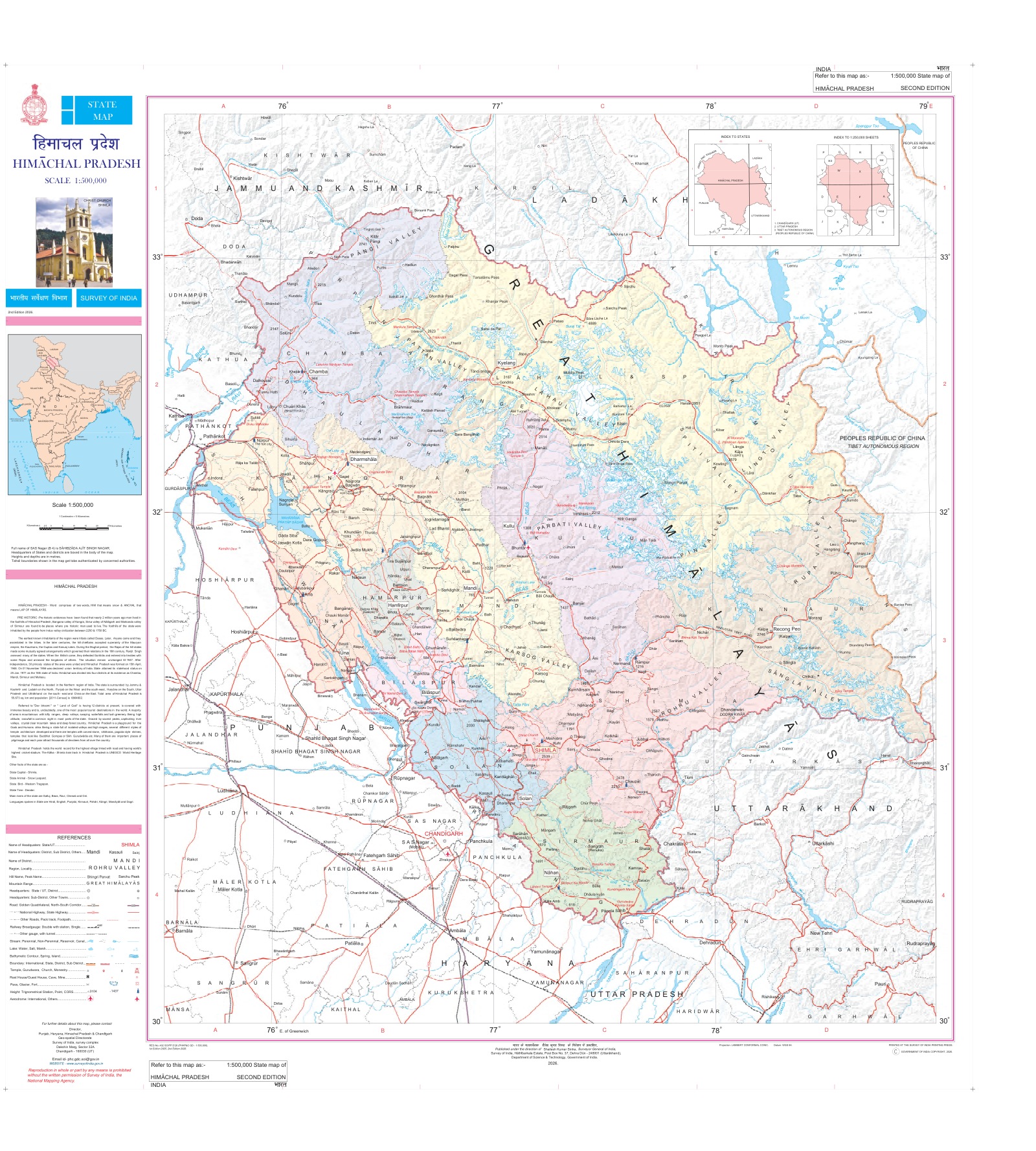
Official geographic context, resized; original source retained. HPMAP
Evidence. Industrial policy and logistics framework recognise manufacturing and supporting infrastructure; CONCOR lists Baddi terminal.
Commercial case. Seek packaging, testing, maintenance and qualified contract services around existing regulated manufacturers.
Exposure. Quality qualification, effluent and truck-route disruption.
Investment gate. Obtain buyer audits, applicable drug/device permissions and access-resilience plan.
Evidence. Official policy and map distinguish accessible industrial areas from hill sites.
Commercial case. Choose higher-value, lower-bulk production that can meet nearby north-India buyers without excessive haul cost.
Exposure. Plot constraints and skills availability.
Investment gate. Compare legal industrial plots, sanctioned load and actual hiring pool.
Evidence. Logistics policy expressly addresses agriculture/horticulture logistics and perishable handling.
Commercial case. Contract packhouse, storage or ingredient processing around verified crop volumes, not tourism traffic.
Exposure. Harvest seasonality, road closures and cold-chain power reliability.
Investment gate. Obtain crop contracts, loss baseline, offtake and contingency transport.
Rationale. Seek packaging, testing, maintenance and qualified contract services around existing regulated manufacturers.
Rationale. Choose higher-value, lower-bulk production that can meet nearby north-India buyers without excessive haul cost.
Rationale. Contract packhouse, storage or ingredient processing around verified crop volumes, not tourism traffic.
Assessment. Foothill routes to Chandigarh/Punjab and NH 5/NH 3 hill connections underpin access; slope/bridge/load restrictions and disruption scenarios are essential.
Status. Mapped access; no guaranteed all-weather transit time
Assessment. CONCOR lists Baddi; terminal presence does not prove rail service to every industrial plot. Ocean exports continue by inland road/rail to external ports.
Status. Terminal directory verified; shipment routing pending
Assessment. Chandigarh/Mohali and Delhi are external cargo options; state airports support management access but are not assumed industrial cargo hubs.
Status. Cargo capability and booking acceptance unverified
Assessment. No inland-water bulk-freight base case established. Hillside industrial water and effluent disposal require site-specific permission and resilience design.
Status. No verified commercial waterway
Benefits. Historical general investment framework includes location categories and support routes.
Conditions. Eligibility includes minimum 80% bona-fide Himachali employment, subject to applicable provisions and exemptions; negative-list screening is necessary.
Status. Current new-project validity as of 1 November 2026 is NOT established. Do not display these benefits as currently open.
Checked pages. PDF pp 1-5; current extension notification missing
Benefits. Industry status for defined logistics assets and facilitation/land/infrastructure measures; horticultural logistics and specialist training are emphasised.
Conditions. Aspirational projects and proposed approval timelines are not implemented entitlements. Facility category and applicable implementing rules govern.
Status. Original gazetted 30-page instrument retrieved.
Checked pages. Sections 8.2-8.6; pp containing industry status and logistics facilities
Benefits. The logistics policy supplies an enabling route for perishable-chain projects; a separate current sector grant is not established here.
Conditions. Do not quote a cash subsidy without a current original guideline and application window.
Status. Evidence gap, deliberately not substituted with a Cabinet decision.
Checked pages. Horticulture/perishable logistics provisions only
Foothill manufacturing and horticultural belts permit distinct investment models.
Logistics framework recognises specialised hill/perishable needs.
Terrain constrains heavy-load access and usable industrial land.
Current general incentive application window is unresolved.
Shared compliant testing/packaging can serve regulated plants.
Crop aggregation and resilient cold chains can reduce avoidable losses.
Landslides/seasonal disruptions can interrupt inputs and dispatch.
Regulatory qualification and environmental liability can delay returns.
Constraint. Road disruption and seasonal procurement
Intervention. Pre-position critical inputs and dual-source route/storage plans
Owner. Investor and logistics provider
Opportunity. Resilience and cold-chain services
Prerequisite. Quantified interruption scenarios and approved sites
Residual risk. Severe events can defeat redundancy
Constraint. Small horticultural lots
Intervention. Aggregate grading, pre-cooling and traceability
Owner. FPOs and processor
Opportunity. Contracted higher-quality supply
Prerequisite. Crop-volume evidence and buyer grade rules
Residual risk. Harvest and price risks remain
Constraint. Specialist manufacturing skill gaps
Intervention. Create buyer-linked training and qualification cells
Owner. Employer, technical institutes and anchor customers
Opportunity. Validated maintenance/quality services
Prerequisite. Training commitments and local-employment compliance
Residual risk. Retention and qualification delays remain
Critical: recover the operative industrial-policy extension/replacement effective on 1 November 2026. Economic Survey 2025-26 references extension to December 2025; later secondary reports are not sufficient.
Separate current food-processing/sector guideline and application window not recovered.
No guaranteed subsidy cash flow: validate eligibility, budget, application acceptance and stacking for the particular legal entity before financial close.
Cargo, port, railway service frequency, terminal capacity, routes, freight quotes, water allocation and plot availability require project-specific current evidence. No passenger flight is represented as a scheduled freighter.
Central FDI/FEMA, customs, tax, sector licensing and scheme windows are to be read with the common national legal guide; state incentives do not override them.
Central policy, FDI, tax, customs, environment, workforce and remittance guide · Single canonical evidence repository
STARTUP POLICY · CHECKED 4 NOVEMBER 2026
Original official scheme reviewed; listed as continuing in TEJAS, but a fresh consolidated amendment set/current funding call was not located.