Capital / administrative centre
Chandigarh (shared capital; separate UT)

Industrial investment and policy for Viksit Bharat 2047. Evidence reviewed as of 1 November 2026; document dates and unresolved gaps remain explicit.
Read or download investor brochure
Chandigarh (shared capital; separate UT)
44, 212 km² (Mo EF profile)
Northern plains surrounding Delhi on three sides, with industrial concentration along NCR corridors. Proximity to buyers must be balanced against land, labour and clean-air constraints.
Punjab, Himachal Pradesh, Uttar Pradesh, Rajasthan, Delhi NCT and Chandigarh UT.
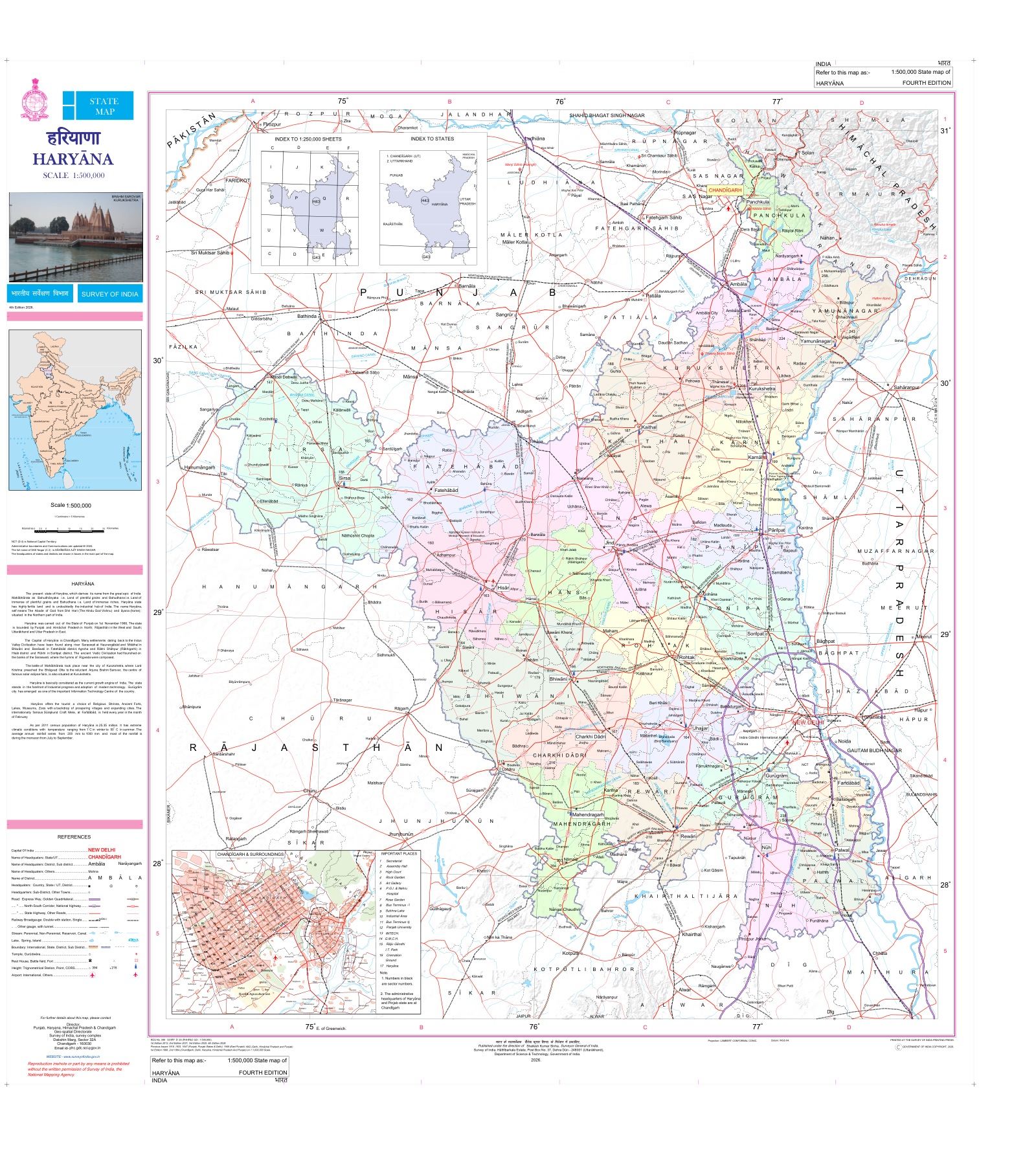
Official geographic context, resized; original source retained. HRMAP
Evidence. The 2026 industrial policy differentiates established and less-developed areas; the state has a dedicated industrial-estate network.
Commercial case. Evaluate approved components, automation and maintenance near OEM procurement, with expansion options along NH 48.
Exposure. OEM qualification, expensive land and air-quality restrictions.
Investment gate. Obtain anchor procurement acceptance, permitted site use and fuel/emissions design.
Evidence. A separate Haryana Agri-Business and Food Processing Policy 2026 is officially published.
Commercial case. Connect contracted grain/food inputs to NCR consumption and institutional buyers; favour products with defensible shelf life.
Exposure. Thin commodity margins and uneven cold-chain utilisation.
Investment gate. Match crop contracts, water/food-safety permissions and buyer specifications before claiming benefits.
Evidence. ESDM Policy 2026 is an original published sector instrument.
Commercial case. Combine design/service proximity with carefully selected compliant manufacturing sites.
Exposure. Imported components, rapidly changing technology and talent cost.
Investment gate. Verify product certification, import economics, land-use permission and actual sector-policy eligibility.
Rationale. Evaluate approved components, automation and maintenance near OEM procurement, with expansion options along NH 48.
Rationale. Connect contracted grain/food inputs to NCR consumption and institutional buyers; favour products with defensible shelf life.
Rationale. Combine design/service proximity with carefully selected compliant manufacturing sites.
Assessment. NH 48, NH 44 and peripheral expressway geography support NCR and north-India access. Congestion and commercial-vehicle restrictions must enter the delivery model.
Status. Existing mapped corridors; measured lead times pending
Assessment. Rewari/western corridor and Barhi-area terminal options merit quotation. Haryana Orbital Rail Corridor must not be treated as fully operational without current completion evidence.
Status. Directory/mapping basis only; service-specific verification needed
Assessment. Delhi IGI is a major nearby gateway outside Haryana; plan bonded/temperature-controlled road transfer where needed. Passenger proximity alone does not prove cargo acceptance.
Status. External gateway; current cargo contracts not verified
Assessment. No proven inland-water industrial freight route in this dossier. Confirm industrial water allocation and reuse, especially NCR sites.
Status. Land transport base case
Benefits. Net SGST reimbursement differentiates the proportion of intra-state B 2 C sales and area classification. Fast commencement, local employment and other support are conditional.
Conditions. Principal fiscal provisions apply only to Ultra-Mega, Mega and Large units satisfying section 8. Do not apply these rates to MSMEs. SGST calculation uses annual certification; capital assistance is time-linked.
Status. Gazette 26 May 2026; supersedes HEEP 2020; five-year validity or earlier replacement/amendment.
Checked pages. PDF pp 1-5, 27-33; clauses 13.2-13.3.4
Benefits. Sector-specific route exists for electronics design/manufacturing; no headline rate asserted.
Conditions. Product, investment, location, application and stacking conditions require full clause review.
Status. Original 45-page gazetted PDF retrieved; benefits not yet fully verified.
Checked pages. Cover identity only; fiscal clauses require review
Benefits. Separate food-processing instrument exists; compare it with general industrial support only after sector qualification.
Conditions. Original project thresholds, eligible costs, claim sequence and overlap require clause verification.
Status. Original 40-page PDF retrieved from the official policy link.
Checked pages. Document identity; detailed clauses pending
NCR proximity provides a concentrated buyer and service ecosystem.
Current general and sector-specific 2026 instruments are published.
NCR land, congestion and labour costs may offset proximity benefits.
Air-quality compliance can constrain fuels and operating patterns.
Automation, approved supplier development and clean industrial services can deepen clusters.
Food aggregation can serve nearby demand with measurable logistics savings.
Customer concentration and technology transition affect supplier plants.
Changing emissions directions and water scarcity require operating contingencies.
Constraint. High land cost near buyers
Intervention. Separate permitted production from customer-facing services and compare corridor sites
Owner. Investor and estate developer
Opportunity. Cost-efficient approved supplier capacity
Prerequisite. Lead-time simulation and legal site-use permission
Residual risk. Extra transfer cost and management complexity remain
Constraint. Air-quality restrictions
Intervention. Design compliant clean-fuel processes and backup power from inception
Owner. Investor, utility and pollution-control authority
Opportunity. Retrofit and energy-services demand
Prerequisite. Current CAQM/GRAP review and assured fuel supply
Residual risk. Future tightening and fuel price remain
Constraint. Seasonal agricultural supply
Intervention. Contract aggregation, packhouse and measured cold chain
Owner. Processor, FPOs and distributor
Opportunity. Reduced loss and institutional food supply
Prerequisite. Anchor demand and food-safety approvals
Residual risk. Seasonal utilisation and working-capital risk remain
Sector-policy fiscal tables need selected-page verification; no old HEEP 2020 headline incentives are reused.
Rewari/WDFC route completion and terminal service must be checked against current operator records; no proposed orbital line is counted as operating.
No guaranteed subsidy cash flow: validate eligibility, budget, application acceptance and stacking for the particular legal entity before financial close.
Cargo, port, railway service frequency, terminal capacity, routes, freight quotes, water allocation and plot availability require project-specific current evidence. No passenger flight is represented as a scheduled freighter.
Central FDI/FEMA, customs, tax, sector licensing and scheme windows are to be read with the common national legal guide; state incentives do not override them.
Central policy, FDI, tax, customs, environment, workforce and remittance guide · Single canonical evidence repository
STARTUP POLICY · CHECKED 4 NOVEMBER 2026
Official policy notified 7 July 2022 reviewed; assistance is governed by incentive-specific implementation rules.