Capital / administrative centre
New Delhi

Industrial investment and policy for Viksit Bharat 2047. Evidence reviewed as of 1 November 2026; document dates and unresolved gaps remain explicit.
Read or download investor brochure
New Delhi
1, 483 km² (Mo EF profile)
Dense landlocked metropolitan territory. Screen knowledge-intensive and permitted low-pollution activities; heavy manufacturing cannot be assumed admissible merely because an industrial address exists.
Haryana and Uttar Pradesh.
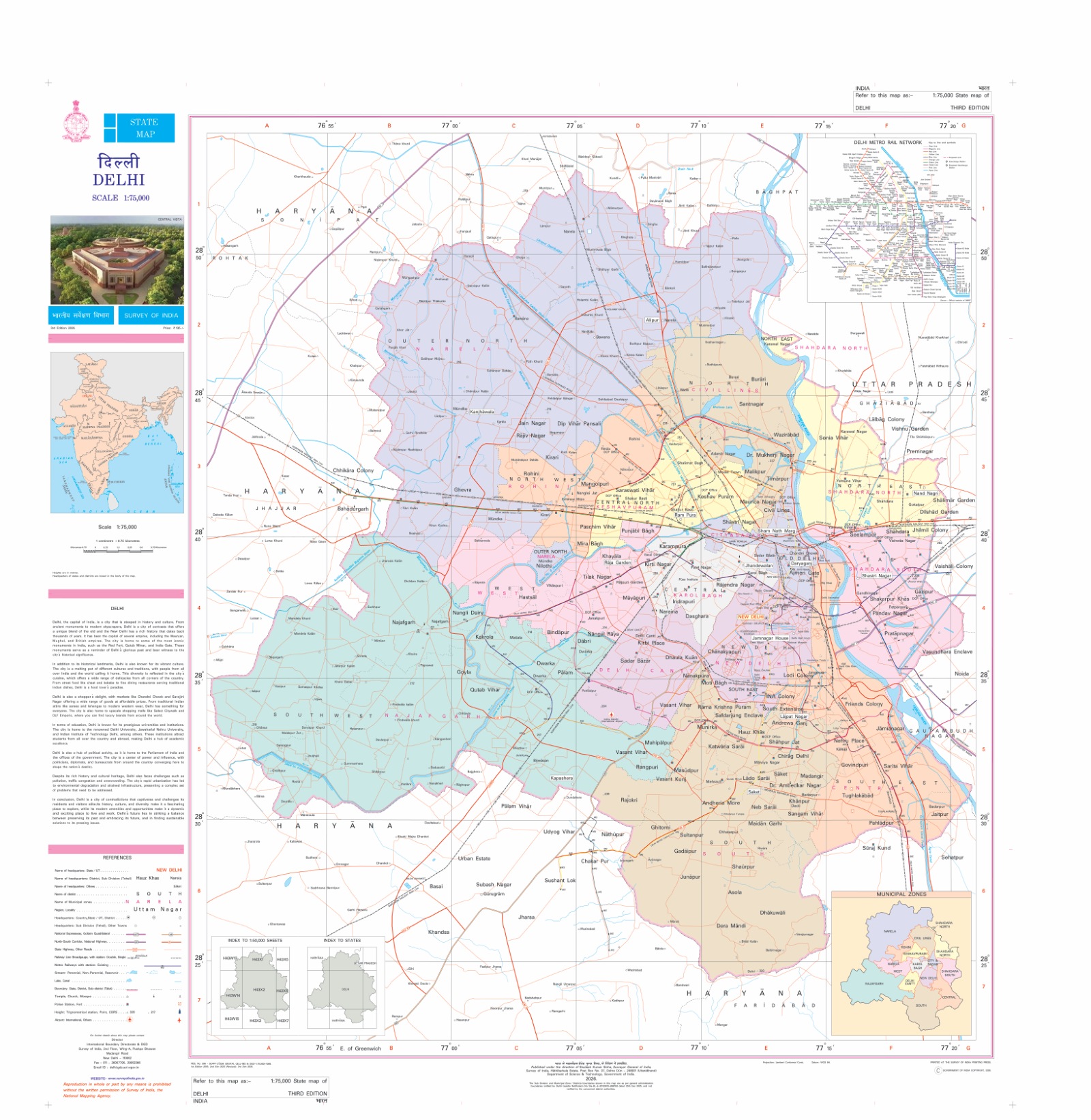
Official geographic context, resized; original source retained. DLMAP
Evidence. The historical policy and 2025 draft emphasise cleaner/knowledge-intensive industry; legal land use and pollution permissions remain decisive.
Commercial case. Evaluate prototypes, testing and high-value low-bulk production only where the specific activity is permitted.
Exposure. Land-use incompatibility, emissions and high occupancy costs.
Investment gate. Obtain sanctioned use, DPCC category/consent and current fuel/GRAP compliance before lease.
Evidence. Industrial-area redevelopment and cleaner production are policy themes; these are existing named estate geographies, not proof of vacant plots.
Commercial case. Serve approved units with process efficiency, maintenance, packaging and waste-compliance services.
Exposure. Utilities, access and waste disposal may be decisive.
Investment gate. Verify customer contracts, estate infrastructure and authorised handling/disposal.
Evidence. Knowledge-based economic activity is a policy direction, while the 2025-35 document remains a draft.
Commercial case. Use proximity to national decision makers, customers and Delhi airport for non-heavy activities; manufacturing can require another compliant jurisdiction.
Exposure. Talent/lease cost and regulated-service approvals.
Investment gate. Validate permitted premises, specialist accreditation and buyer demand; exclude unnotified draft subsidies.
Rationale. Evaluate prototypes, testing and high-value low-bulk production only where the specific activity is permitted.
Rationale. Serve approved units with process efficiency, maintenance, packaging and waste-compliance services.
Rationale. Use proximity to national decision makers, customers and Delhi airport for non-heavy activities; manufacturing can require another compliant jurisdiction.
Assessment. Dense NCR road access is counterbalanced by vehicle restrictions, congestion and GRAP measures. Quote compliant vehicle movements for actual time windows.
Status. Existing network; current restrictions require trip-level check
Assessment. Tughlakabad is listed in CONCOR’s terminal network; Delhi-region terminals allow container-route screening to seaports.
Status. Listed node; customs, commodity and train acceptance need confirmation
Assessment. IGI is an external-trade gateway within NCT; secure actual airline, handler, customs and temperature-control acceptance rather than rely on airport proximity.
Status. Airport geography verified; cargo-service details not independently checked here
Assessment. Yamuna is not an evidenced commercial freight alternative in this dossier. Industrial abstraction and discharge require specific permission.
Status. No proven waterway cargo route
Benefits. No fiscal entitlement may be claimed from this document. It is useful solely to understand a proposed direction.
Conditions. Public consultation does not create legal eligibility or an open incentive window.
Status. Draft identity verified on official public notice; final notified successor not located.
Checked pages. Cover and public-notice identity
Benefits. Historical framework provides cleaner/knowledge-intensive industrial direction.
Conditions. Stated plan period ended 2021; present enforceability of individual measures requires their underlying law/notification.
Status. Original 42-page document retrieved; not represented as current cash-incentive offer.
Checked pages. Section 20 phasing; PDF contains original policy
Benefits. Compliant fuels, emissions, permitted industrial activity and GRAP operating rules are investment gates, not incentives.
Conditions. Check latest directions, applicable pollution category, consent and sanctioned use; do not assume the 2025 draft relaxes binding controls.
Status. Current official directions index identified; project-specific legal matrix still required.
Checked pages. Latest applicable direction must be selected for process/fuel/vehicle
National-market access and services ecosystem support specialist activity.
Rail-container and airport geography provide gateway choices.
Dense urban land and congestion raise operating costs.
Manufacturing use is tightly constrained by land-use and pollution controls.
Industrial resource-efficiency and compliant process services can solve existing-unit needs.
Design and export services can exploit proximity without heavy-plant footprint.
Air-quality emergency rules can disrupt operations and freight.
Basing investment economics on draft incentives creates entitlement risk.
Constraint. Tight pollution and operating constraints
Intervention. Design clean processes and accredited compliance services
Owner. Investor, authorised service providers and DPCC
Opportunity. Demand for energy/emissions efficiency services
Prerequisite. Process-specific permission and verified economics
Residual risk. Rules may tighten further
Constraint. High premises cost
Intervention. Separate only legally permissible design/prototype functions from bulk production
Owner. Investor and planning/estate authorities
Opportunity. Specialist design and testing hub
Prerequisite. Permitted-use documents and transfer-cost model
Residual risk. Coordination and lease costs remain
Constraint. Fragmented smaller industrial compliance needs
Intervention. Offer shared authorised testing, maintenance and waste documentation
Owner. Industry association and licensed operators
Opportunity. Recurring specialist service contracts
Prerequisite. Valid licences and auditable customer chain
Residual risk. Liability persists; no informal disposal
Critical: no final notified Delhi Industrial Policy 2025-35 located; do not badge the draft as enacted.
Need parcel/process-specific DDA/DSIIDC/DPCC originals and latest CAQM directions for a bankable activity recommendation.
No guaranteed subsidy cash flow: validate eligibility, budget, application acceptance and stacking for the particular legal entity before financial close.
Cargo, port, railway service frequency, terminal capacity, routes, freight quotes, water allocation and plot availability require project-specific current evidence. No passenger flight is represented as a scheduled freighter.
Central FDI/FEMA, customs, tax, sector licensing and scheme windows are to be read with the common national legal guide; state incentives do not override them.
Central policy, FDI, tax, customs, environment, workforce and remittance guide · Single canonical evidence repository
STARTUP POLICY · CHECKED 4 NOVEMBER 2026
DPIIT’s July 2026 directory labels the startup policy as being conceptualised; a 2026 government MSME/startup scheme compendium is available.